

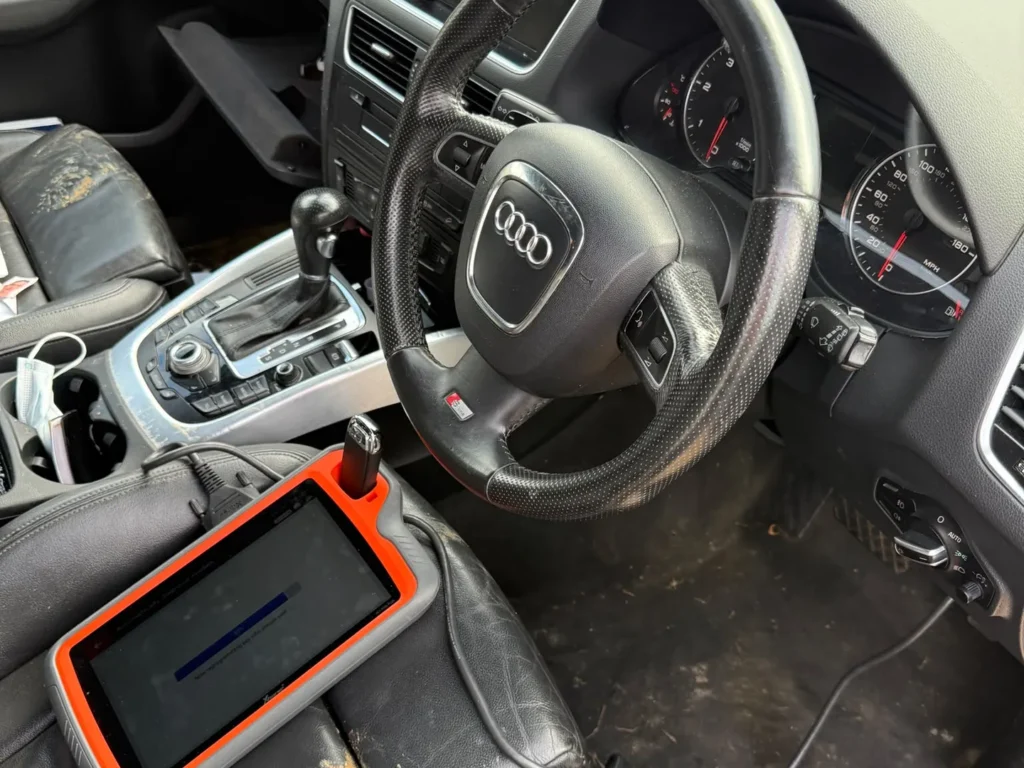
Most keys that will not turn are being held by the steering lock, or, on an automatic, by a gear selector that is not quite in Park. Both take seconds to free, so try them first. If neither works, the problem is either the key or the ignition barrel, and your spare key tells you which. Whatever happens, do not force it: a key snapped in the ignition turns a two-minute problem into a repair.
Which sign points to which cause?
| What happens | Most likely cause | Try first |
|---|---|---|
| Key will not turn and the steering wheel feels solid | Steering lock under load | Turn the wheel and the key together |
| Automatic, key will not turn back or come out | Selector not fully in Park | Foot on the brake, selector firmly into P |
| Key turns only after wiggling | Worn key, or a worn barrel | Try the spare |
| The spare turns smoothly | Worn or damaged original key | A new key cut to code |
| The spare will not turn either | Worn or damaged ignition barrel | Barrel repair or replacement |
| Key will not go all the way in | Bent key, or debris in the lock | A torch, and no forcing |
| Keyless car, start button does nothing | Flat fob battery | The fob’s backup start position |
1. The steering lock has engaged
When the engine is off and the steering wheel is turned, a steering lock drops a pin into the column. If the front wheels were left turned against a kerb, that pin is under load, and it grips the ignition so the key will not move.
Turn the steering wheel firmly in the direction it gives slightly, hold it there, and turn the key gently at the same time. You will feel the lock let go. Put the effort into the wheel and keep the key movement gentle.
2. The gear selector is not in Park
On most automatic cars the key will not turn back to off, or come out, unless the selector is fully in P. Put your foot on the brake, move the selector firmly into Park, and try again. If the selector already shows P, rock it gently in its slot while you turn the key. A worn selector switch sometimes needs that nudge to register.
3. The key is worn, bent or damaged
Keys wear with use. The cuts that lift the wafers inside the lock round off over the years, and a worn key often still opens the door while refusing to turn in the ignition, or turns only after some jiggling. A bent key may not go in fully. Try the spare: if the spare turns smoothly, the original key is the problem.
The fix is a new key cut to code. A copy of a worn key copies the wear as well, while cutting from the manufacturer’s code gives you a blade made to the original measurements. See car key cutting.
4. The ignition barrel is worn or damaged
If the spare will not turn either, the lock itself is the likely cause. The small wafers inside an ignition barrel wear, stick or break with age, and a barrel that has been forced, or damaged in a theft attempt, can stop turning altogether. A sticking barrel usually gets gradually worse before it fails, so a key that needs more jiggling every week is a warning worth acting on.
A worn barrel can be repaired, or replaced and matched to your key, where the car is parked. That is ignition repair and barrel replacement, and it saves a recovery to a garage.
5. Dirt or a broken piece in the lock
Grit, pocket fluff or a fragment of an old key can stop the wafers moving. Look into the keyway with a torch. Do not dig at it with anything sharp, and keep oil and grease away from it, because they hold dirt and make the problem worse later. A small puff of a dry lock lubricant, graphite or PTFE, is as far as it is worth going yourself. If part of a key has broken off inside, see broken key extraction.
6. A flat battery, or a keyless car
On a car with a traditional key, a flat car battery does not usually stop the key turning, although the engine will not crank. Cars with an electronic steering lock or push-button start are different: the system needs power to release, so a flat battery can look like a key or button fault.
On keyless cars the most common cause is a flat battery in the fob itself. Most have a backup way to start: hold the fob against the start button, or in a marked slot, and press start. Your handbook shows where. There is more in can you start a car without the key fob?
What not to do
Do not use pliers on the key or lean your weight on it. Car keys snap, and a key broken in the ignition means an extraction and a new key on top of the original fault. Do not hit the barrel, spray household oil into it, or try a key from another car. If a few minutes with the checks above have not worked, stop there and call.
When should you call an auto locksmith?
Call when the steering and gear checks have not freed the key, when the spare will not turn either, when a key has broken in the lock, or when a key turns only on a good day. We come to the car, find the cause, and fix it there: a new key cut to code, a barrel repaired or replaced, or a broken key extracted. The price is agreed on the phone before anyone sets off.
Key stuck now? Call 0333 772 1846. See ignition repair, broken key extraction and car key cutting.